
Artist Statement
My painting is rooted in Constructivism and incorporates elements of realism, Expressionism, and Surrealism. From this interplay emerges an independent, complex visual language shaped by the tension between abstraction and representation, Constructivist rationality and expression, rational structure and subjective experience.
The formal basis of my work is a technique of serial variation that I have developed myself, inspired by principles of musical composition. It enables the creation of unusual, asymmetrical structures that serve as the foundation for thematic compositions. Within these constructive frameworks, personal emotions and sensory experience are given visual form.
This concept opens a wide range of artistic possibilities. Recurring themes in my work include cosmological studies, constructivist-architectural landscapes, marine and sailing motifs, pictorial responses to musical works, geometric still lifes, and other related subjects.
Many of my paintings possess a playful, at times ironic and surreal quality. Others confront existential themes such as death and mortality. A further group of works explores the darker side of modernity: the dialectic of rationalization, the relationship between rationalism and totalitarianism, and the tension between rational construction and unrestrained destruction.
Through this artistic approach, I seek a path from abstraction back to inner and outer aesthetic as well as historical experience. My aim is to represent reality in a way that reveals one of the defining principles of modernity: the dialectic of rationalization.
The driving forces of modernization — Enlightenment, science, technology, and economic rationality — embody this dialectic. They expand the possibilities for human action while simultaneously generating new forms of constraint. The disenchantment of the world through rationalization therefore signifies not only the loss of immediate experience; it also creates the possibility of imagining utopias and of reclaiming the world through creative freedom.
Within this field of tension between systemic constraint and autonomy, between emptiness and free artistic creation, I strive to develop my own visual language.
My work consists primarily of oil paintings. I have also created a series of watercolours exploring the idea of playful geometry. Geometric figures and structures appear in many of my oil paintings as well, often adding a subtle surrealist dimension.
My paintings combine modern principles of construction with a traditional technique inspired, among other sources, by Dutch painting of the seventeenth century. It is precisely this dialogue between modernity and tradition that I find particularly compelling.
My aim is to recover traditional possibilities in painting through what I call Serial and Expressive Constructivism. While my work defines an independent artistic position, it remains indebted to major pioneers of modern art, including Piet Mondrian, Wassily Kandinsky, and Max Ernst.
The foundations of this concept were developed during my youth. Throughout my university studies and subsequent academic career, I pursued painting alongside my scholarly work.
It was only between 1998 and 2002, when I had the opportunity to take a break from my professional work at the university for a few years, that I was able to develop this artistic concept fully. Most of my paintings were created during that period. They were shown in several exhibitions, and a number of works were acquired by collectors.
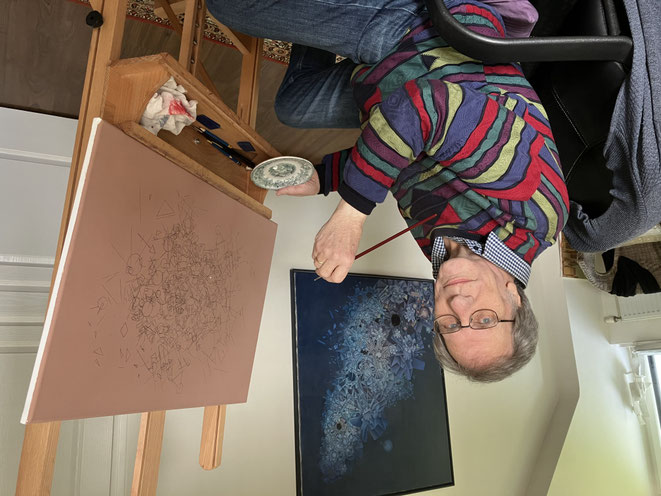
In the years that followed, my academic career left little time for painting or for presenting my work publicly. After completing my academic work in 2025, I returned to my artistic practice at the age of 76. After two decades of intensive research on National Socialism, painting once again became an essential counterbalance: a space of creative freedom and artistic imagination.
Déclaration d’artiste
Ma peinture part du constructivisme tout en intégrant des éléments réalistes, expressionnistes et surréalistes. De cette rencontre naît un langage plastique personnel et complexe, déployé dans la tension entre abstraction et figuration, rationalité constructiviste et expression, construction rationnelle et expérience sensible.
Le fondement formel de mon travail repose sur une technique de variation sérielle que j’ai développée à partir de principes de composition musicale. Elle permet de créer des structures inhabituelles et asymétriques, qui servent de base à des compositions thématiques. Mes émotions et perceptions personnelles y trouvent également leur place.
Cette conception ouvre un vaste champ de possibilités plastiques. Les thèmes récurrents de mon œuvre comprennent des études cosmologiques, des paysages constructivistes à dimension architecturale, des motifs maritimes et de navigation à voile, des interprétations picturales d’œuvres musicales, des natures mortes géométriques ainsi que d’autres ensembles thématiques.
Nombre de mes peintures ont une dimension ludique, parfois ironique et surréaliste. D’autres abordent des questions existentielles, comme la mort et la finitude. Certaines séries explorent aussi les faces sombres de la modernité : la dialectique de la rationalisation, les rapports entre rationalisme et totalitarisme, ainsi que la tension entre construction rationnelle et destruction déchaînée.
Par cette technique, je cherche à passer de l’abstraction à une expérience esthétique et historique, à la fois intérieure et extérieure. Mon intention est de représenter la réalité de façon à rendre perceptible l’un des principes constitutifs de la modernité : la dialectique de la rationalisation.
Les forces motrices de la modernisation — les Lumières, la science, la technologie et la rationalité économique — portent cette dialectique en elles. Elles élargissent les possibilités d’action tout en produisant de nouvelles formes de contrainte. Le désenchantement du monde par la rationalisation ne signifie donc pas seulement la perte de l’expérience immédiate; il ouvre aussi la possibilité d’imaginer des utopies et de se réapproprier le monde par la liberté créatrice.
C’est dans cette tension entre contrainte systémique et autonomie, entre appauvrissement de l’expérience et création libre, que je m’efforce de développer mon propre langage plastique.
L’essentiel de mon œuvre est constitué de peintures à l’huile. J’ai également réalisé une série d’aquarelles explorant l’idée d’une géométrie ludique. Des figures et structures géométriques apparaissent aussi dans nombre de mes huiles, où elles introduisent souvent une tonalité surréaliste.
Dans mes tableaux, j’associe des principes de construction modernes à une technique picturale traditionnelle, notamment inspirée de la peinture hollandaise du XVIIᵉ siècle. Ce dialogue entre modernité et tradition constitue, à mes yeux, l’un des aspects les plus stimulants de mon travail.
Mon objectif est de retrouver des possibilités traditionnelles de la peinture à partir de ce que j’appelle le Constructivisme sériel et expressif. Si mon œuvre affirme une position artistique personnelle, elle demeure également redevable aux grands maîtres de la modernité, tels que Piet Mondrian, Vassily Kandinsky et Max Ernst.
Les fondements de cette conception remontent à ma jeunesse. Durant mes études universitaires puis tout au long de ma carrière académique, j’ai poursuivi la peinture parallèlement à mon activité scientifique.
Ce n’est qu’entre 1998 et 2002, lorsque j’ai pu interrompre mon activité universitaire pendant quelques années, que j’ai eu la possibilité de développer pleinement ce projet artistique. La majeure partie de mon œuvre picturale a été réalisée durant cette période. Mes travaux ont été présentés dans plusieurs expositions, et plusieurs tableaux ont rejoint des collections privées.
Au cours des années qui ont suivi, ma carrière académique ne m’a laissé que peu de temps pour peindre ou pour présenter mon travail au public. Après avoir achevé mes travaux universitaires en 2025, j’ai repris ma pratique artistique à l’âge de 76 ans. Après deux décennies de recherches approfondies sur le national-socialisme, la peinture est redevenue un contrepoids essentiel : un espace de liberté créative et d’imagination artistique.
Now follows a text written by ChatGPT:
Artistic profile
Hans-Christian Harten explores the fragile relationship between order and disintegration, memory and destruction. His paintings are inspired by architecture, music, history and philosophy, transforming these fields into powerful visual compositions that balance structure with expressive freedom.
Geometric forms, fragmented spaces and luminous layers of colour create pictorial worlds in which construction and collapse exist simultaneously. Rather than illustrating historical events or architectural concepts, Harten seeks their deeper resonance: the traces that civilizations, ideas and cultural memories leave within us.
Music plays an equally important role in his artistic thinking. The polyphonic structures of Johann Sebastian Bach, the radical innovations of Arnold Schoenberg and the
architectural language of Daniel Libeskind have become lasting sources of inspiration. Their influence is not quoted directly but translated into rhythm, tension and spatial composition.
Before devoting himself entirely to painting, Hans-Christian Harten pursued an academic career as Professor of Sociology and History of Education. His research into culture, ideology and historical consciousness continues to inform his artistic vision, enriching it with intellectual depth while remaining firmly rooted in the language of painting.
His works invite viewers to slow down. They do not offer immediate answers but open spaces for reflection, where beauty and rupture, harmony and conflict coexist. Each
painting becomes an invitation to discover new relationships between form, history and human experience.
Today Hans-Christian Harten lives and works in France. His paintings are held in private collections in several countries and are presented internationally through selected exhibitions and online galleries. Actually his work is presented at Singular.com